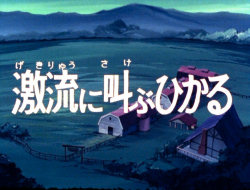
Monsieur Vilak a écrit : ↑mer. mars 18, 2026 18:55 pm
Vu sur une page FB sur Grendizer U :
"It has been pointed out that this scene was just a pay a homage to a famous novel... meaning it was not done to imply any romantic feeling from Duke’s side. despite what her fans—who are drowning in delusions to the core—might think!

They just wanted to honor the classic novel and pay tribute to the legendary author Yukio Mishima and his novel The Sound of Waves (Shiosai in Japanese) despite the setting is different

Why did the artbook mention this novel? In Japanese media, the "drying off by a fire in a storm" scene is a very well-known literary homage to Mishima's work. The Grendizer guidebook indicates that the anime’s directors used this classic imagery to highlight Duke acting as a fiercely protective, brotherly figure to Hikaru, comforting her as she processes the shocking truth of his alien identity. The actual dynamic on screen is purely that of an older brother looking out for and protecting his younger sister.
The text under the picture is only talking about Hikaru and says absolutely nothing about Duke having any feelings for her.
The exact translation of the text written under the picture:
'Episode 23, where Hikaru, having almost drowned in the river and simultaneously learned Daisuke's true identity, warms her body inside a cave. It is a scene that brings to mind Yukio Mishima's classic coming-of-age novel, The Sound of Waves.'"
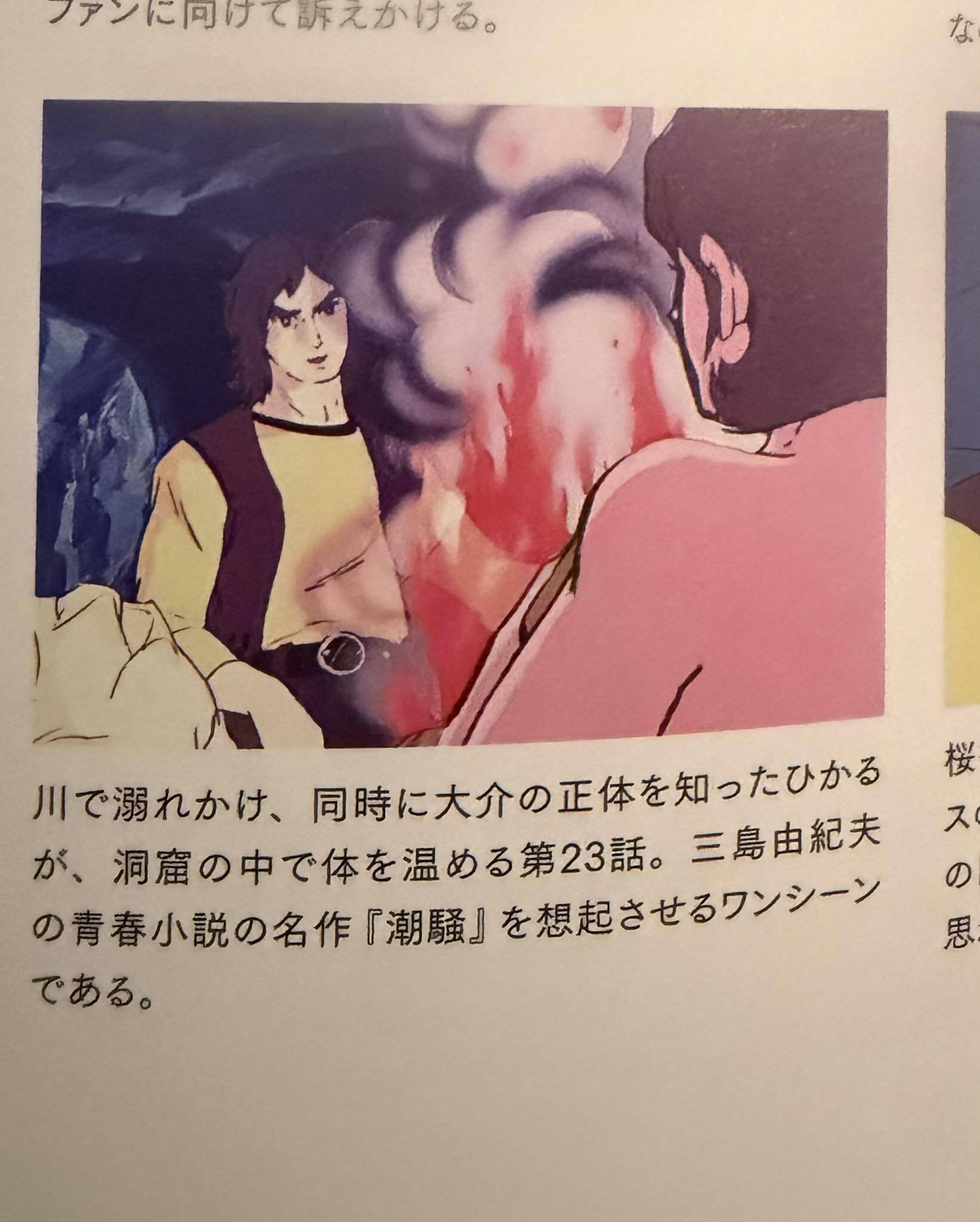
What is suggested in the artbook about the scene in the the cave has intrigued me very much, so I Iooked for the passage in "Shiosai" by Mishima that, according to the artbook's author, may have inspired the scene. Unfortunately I couldn't find the original text in Japanese, but I found an online synopsis of that passage (chapt. 8 of the book) in Japanese and translated into French with AI. Here you are:
Un jour de fermeture de la pêche, sous la pluie, Shinji avait donné rendez-vous à Hatsue au poste de surveillance. Le jour de la tempête, il était arrivé le premier et attendait Hatsue, mais, réchauffé par le feu de camp, il s'était assoupi. Lorsqu’il se réveilla soudainement, il aperçut Hatsue en train d’enlever ses sous-vêtements pour les faire sécher. Ayant été vue nue, Hatsue, prise de honte, demanda à Shinji de se déshabiller lui aussi.
Face à Shinji désormais nu, Hatsue lui dit : « Saute par-dessus ce feu. Si tu sautes par-dessus ce feu... » Après avoir sauté par-dessus le feu, Shinji et Hatsue s'étreignent, tous deux nus, mais la promesse de Hatsue (« Ce n'est pas le moment. J'ai décidé de devenir ta femme ») et la piété de Shinji envers la morale les poussent à réprimer leur impulsion.
My personal impression is that this passage of Mishima's novel has very little to do with the scene in ep. 23. Even though there are some common elements (the clothes put by the fire to dry off and the fact that both the girls are undressed), the moods of the two scenes are very different, and the characters' behaviour in each scene is also very much different.
When Venusia wakes up and realizes she has been undressed by Actarus, in Japanese she says the word "hidoiwa!" to him, which means somehing like awful or horrible, meaning that she is very upset with him.
On the other side, in the novel it is the girl, Hatsue, who undresses herself, and she also asks the boy, Shinji, to undress and entices him.